
How Vibratory Rollers Achieve High-Density Results
In the world of civil engineering and infrastructure development, achieving optimal compaction is paramount for the longevity and stability of roadways, foundations, and various construction projects. Among the array of compaction equipment, the vibratory roller stands out for its superior ability to achieve high-density results.
But what exactly is the science behind this powerful machine? This article delves into the fundamental working principles of vibratory rollers and how they deliver such effective compaction.
Beyond Static Pressure: The Core Concept of Vibratory Compaction
Traditional static rollers rely solely on their immense weight to compact materials. While effective to a degree, this method primarily applies pressure to the surface, leaving deeper layers less densified. Vibratory rollers, however, introduce an additional, dynamic force: vibration. This combination of static weight and dynamic vibratory force is what makes them exceptionally efficient at soil compaction and asphalt compaction.
The core idea is to reduce the internal friction between material particles (whether it’s soil, aggregate, or asphalt mix) by shaking them. This temporary reduction in friction allows particles to rearrange themselves into a denser configuration, filling voids and expelling air.
Key Components and Their Roles in Vibration
The magic of a vibratory roller lies in its drum, specifically what’s inside it:
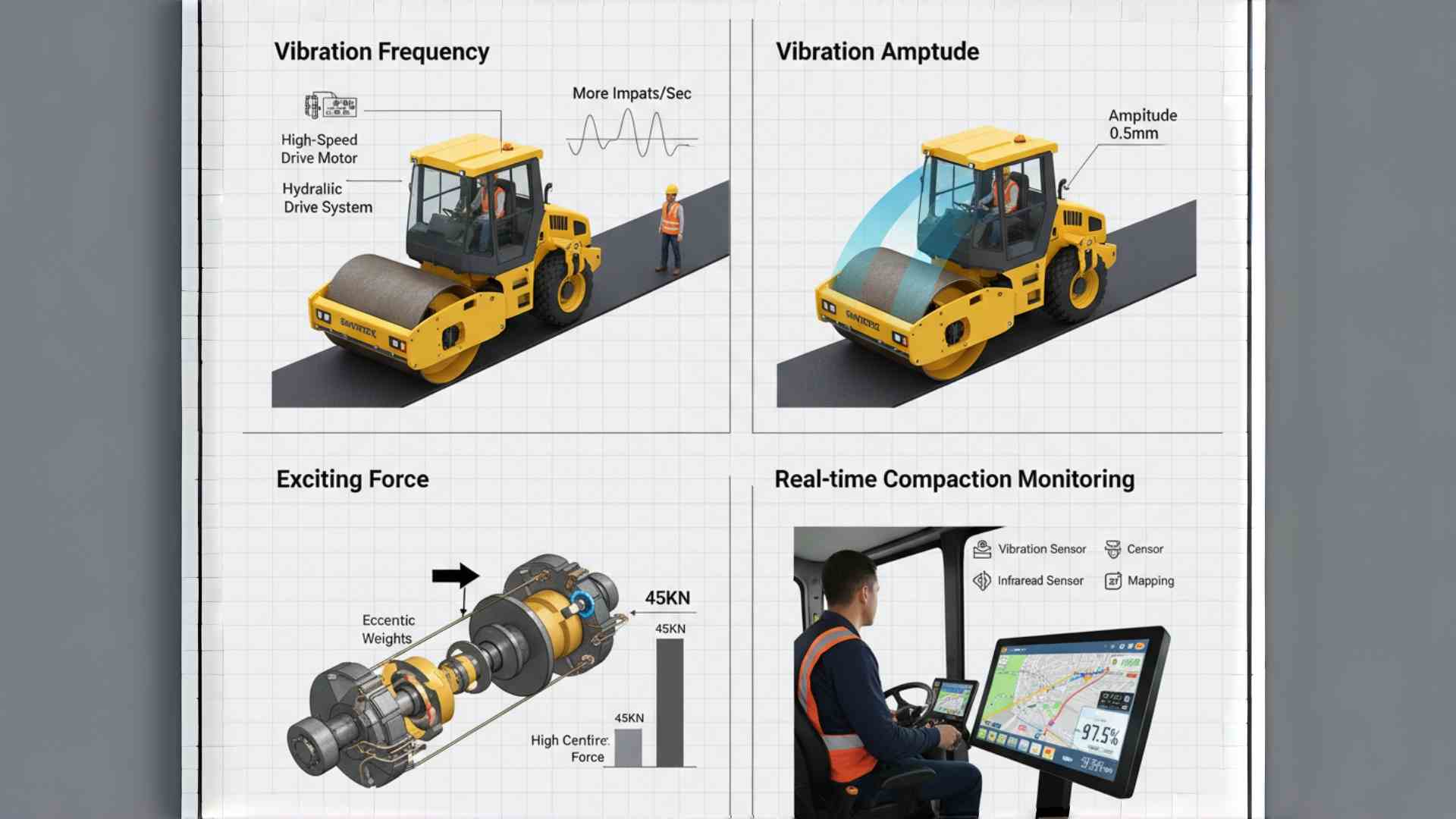
- Eccentric Weights: This is the heart of the vibration system. Inside the roller drum, one or more shafts are fitted with eccentric (unbalanced) weights. As these shafts rotate at high speed, the centrifugal force generated by the rotating unbalanced mass causes the drum to vibrate.
- Vibration Shaft/Exciter Shaft : The shaft(s) on which the eccentric weights are mounted. The rotation of this shaft directly dictates the vibration frequency and contributes to the exciting force.
- Vibration Drive System: Typically a hydraulic system, it powers the rotation of the vibration shaft, allowing the operator to control the vibration’s intensity and engagement.
Understanding the Critical Parameters of Vibration
To truly grasp how a vibratory roller works, it’s essential to understand its key operational parameters:
- Vibration Frequency: This refers to how many times the drum vibrates per second, measured in Hertz (Hz). A higher frequency means more impacts per unit of time, which is generally effective for thinner layers and granular materials, promoting rapid particle rearrangement. For instance, our Sinotech LT304 operates at a frequency of 46Hz, indicating rapid and consistent energy transfer.
- Vibration Amplitude: This is the maximum vertical displacement of the drum from its neutral position during vibration, usually measured in millimeters (mm). Amplitude dictates the “punch” or impact force. Larger amplitudes are crucial for thicker layers and cohesive soils, as they can transmit energy deeper into the material. The Sinotech LT304, with a theoretical amplitude of 0.5mm, is designed to deliver effective depth penetration.
- Exciting Force: Also known as centrifugal force, this is the dynamic force generated by the rotating eccentric weights, measured in Kilonewtons (KN). It’s a combination of frequency and amplitude, representing the total energy transmitted to the material. A higher exciting force, like the 45KN of the LT304, translates directly to greater compaction capability, enabling the roller to densify even challenging materials efficiently.
How These Parameters Synergize for High-Density Compaction
When a vibratory roller is engaged, its drum begins to vibrate rapidly. This vibration, combined with the roller’s static weight, achieves compaction through several mechanisms:
- Particle Rearrangement: The dynamic vibratory energy temporarily reduces the internal friction between soil or aggregate particles. This allows them to “settle” and reorient themselves into a denser, more interlocking structure, reducing voids.
- Expulsion of Air: As particles move closer together, trapped air is expelled from the material, further increasing its density.
- Increased Compaction Depth: Unlike static rollers, the vibratory energy penetrates deeper into the material, compacting layers that static pressure alone cannot effectively reach. This is particularly important for achieving uniform density throughout the entire compacted layer.
- Resonance (in certain conditions): In some cases, the vibration frequency of the roller can resonate with the natural frequency of the material being compacted, leading to an even more efficient and deeper compaction effect.
Applications: Achieving Optimal Densification
Vibratory rollers are versatile machines, indispensable across a wide range of projects:
- Road Construction: Crucial for compacting asphalt layers to achieve a smooth, durable, and long-lasting road surface. The vibration ensures proper aggregate interlocking within the asphalt mix.
- Foundation Preparation: Essential for compacting subgrades and aggregate bases for buildings, bridges, and industrial facilities, providing a stable and load-bearing foundation.
- Dam & Embankment Construction: Used to compact large volumes of soil and rock fill to create stable earth structures.
- Airport Runways & Railway Beds: Demanding applications where very high and consistent compaction densities are required for safety and performance.
Optimizing Performance: Beyond the Basics
Achieving the best compaction results also depends on several operational factors:
- Material Type: Different materials (e.g., granular, cohesive soil, asphalt mix) respond differently to vibration. Operators often adjust frequency and amplitude based on the material.
- Layer Thickness: Thicker layers generally require higher amplitude, while thinner layers benefit from higher frequency.
- Number of Passes: The optimal number of passes ensures full compaction without over-compaction, which can damage some materials.
- Roller Speed: Maintaining a consistent, appropriate speed is vital for uniform compaction.
- Moisture Content (for soil): The right moisture content is critical for effective soil compaction.