
Solid vs. Pneumatic vs. Foam-Filled Tires
In the heavy machinery industry, uptime is currency. For rough terrain forklifts operating on mining sites, lumber yards, or construction zones, the choice of tires is often the difference between a profitable week and a logistical nightmare.
Choosing the wrong tire doesn’t just mean a bumpy ride; it means comprised safety, blown budgets on industrial tire maintenance, and accelerated wear on axles and transmissions.
Today, we go beyond the basics. We are analyzing the three heavyweights—Pneumatic (Air), Solid (Resilient/Aperture), and Foam-Filled (Poly-fill)—with a focus on technical data, stability safety factors, and terrain adaptability.
Technical Definitions: Beyond the Basics
To make an informed decision, we must clarify exactly what technology we are comparing.
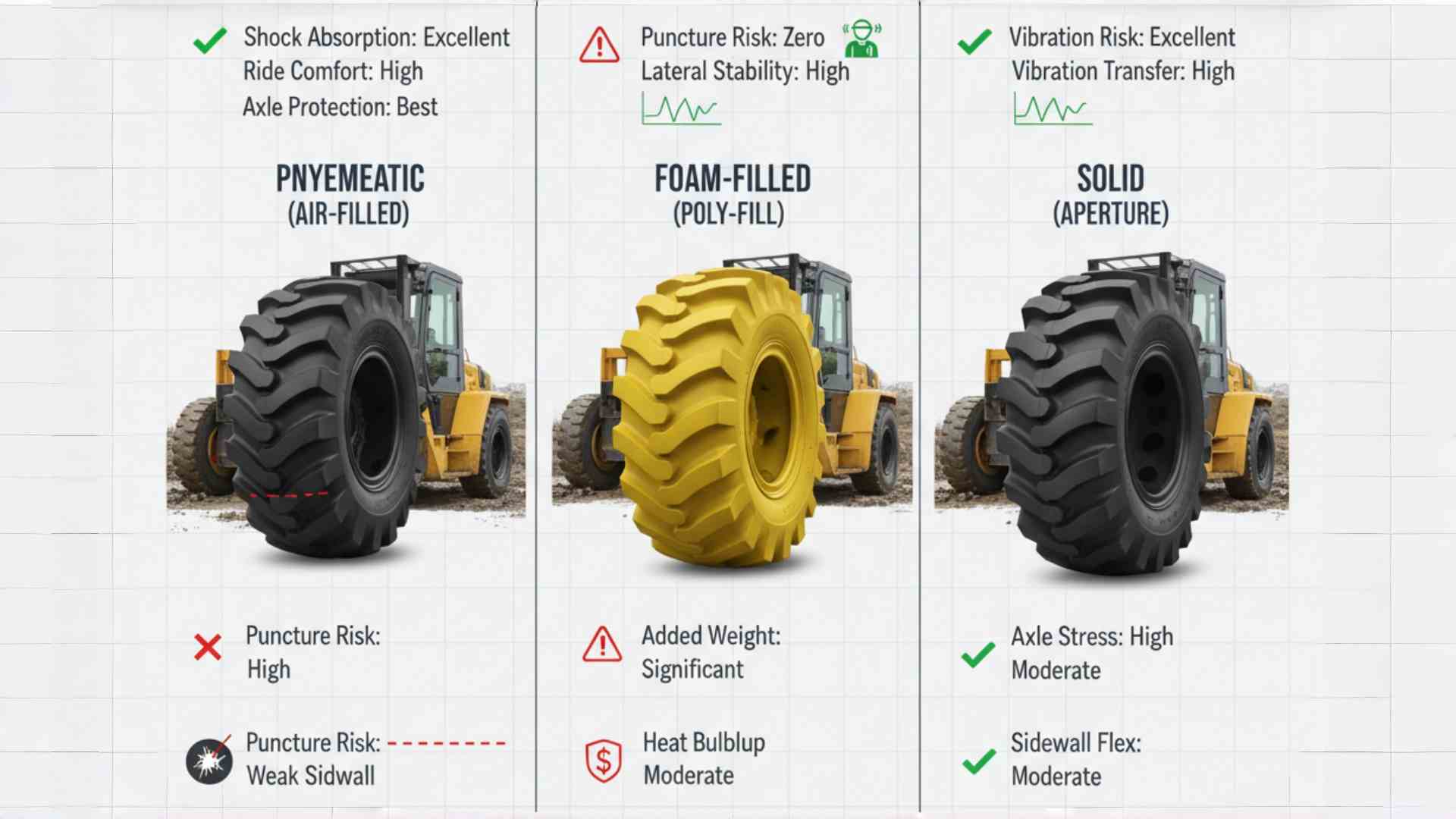
- Pneumatic Tires: Standard industrial tires filled with compressed air. They rely on air pressure to support the load and absorb shock.
- Foam-Filled Tires (Poly-fill): A pneumatic tire casing injected with a polyurethane liquid that cures into a solid, synthetic rubber core. Note: This process significantly increases the tire weight (often adding hundreds of pounds per tire).
- Solid Resilient Tires (Solid Pneumatic Profile): Made of solid rubber compounds.
- Pro Tip: In the rough terrain sector, we often recommend Aperture Solid Tires (tires with sidewall holes). These engineered voids allow the solid rubber to flex, mimicking air cushioning while remaining puncture-proof.
Puncture Risk vs. Sidewall Protection
When operating near scrap metal or jagged rocks, tire sidewall protection is critical.
- Pneumatic: Critical Risk. The sidewall is the weakest point. A slash here means an instant blowout and potential machine tipping.
- Solid / Aperture: Zero Risk. There is no air chamber. You can lose chunks of rubber from the sidewall, and the machine keeps running.
- Foam-Filled: Zero Risk. Even if the sidewall is pierced, the polymer core maintains pressure. It eliminates the “explosive” decompression risk of air tires.
Shock Absorption Data: The “Ride Quality” Reality
This is where many buyers get confused. Shock absorption isn’t just about driver comfort; it’s about protecting the machine’s hydraulic systems from micro-fractures caused by vibration.
We have updated our data to reflect real-world testing conditions:
| Tire Type | Shock Absorption Efficiency | Axle Stress Transmission |
| Pneumatic (Air) | 100% (Reference Standard) | Low (Best protection) |
| Foam-Filled | ~65-70% | Moderate (Polymer core is stiffer than air) |
| Aperture Solid | ~25-30% | High (Holes provide some flex) |
| Standard Solid | ~5-10% | Severe (High vibration transfer) |
If you switch from Air to Solid, you must be prepared for higher maintenance on the machine’s non-tire components due to increased vibration. Aperture designs mitigate this, but Foam-Filled is the closest alternative to Air for ride quality.
Stability & Safety: The Hidden Factor
Most comparisons ignore this, but for high-lifting rough terrain forklifts, Stability > Comfort.
- The “Spring Effect” Risk (Pneumatic): Air tires are bouncy. When lifting a heavy load to height, the air compresses. If the machine turns or hits a bump, the tire “squishes,” causing the center of gravity to shift rapidly. This increases the risk of tip-overs.
- The Stability Advantage (Solid & Foam): Because they are dense and rigid, Solid and Foam-filled tires provide superior Lateral Stability. They do not compress significantly under load.
- Result: Safer high-lifting and better cornering stability, especially on uneven ground.
Terrain Adaptability Matrix (Refined)
We have adjusted our matrix to account for the weight penalty of Foam and Solid tires.
| Terrain Condition | Pneumatic | Foam-Filled | Solid (Aperture/Resilient) |
| Deep Mud / Marsh | ⭐⭐⭐⭐⭐ (Lightweight = Flotation) | ⭐⭐ (Heavy = Sinks Deep) | ⭐ (Heaviest = Gets Stuck) |
| Loose Sand | ⭐⭐⭐⭐⭐ | ⭐⭐ | ⭐ |
| Sharp Rocks / Mining | ⭐ (Blowout Hazard) | ⭐⭐⭐⭐⭐ (Grip + Cut Resistance) | ⭐⭐⭐⭐ (Durable but rough ride) |
| Scrap / Demolition | 🚫 (Unsafe) | ⭐⭐⭐⭐ | ⭐⭐⭐⭐⭐ (Indestructible) |
| Concrete / Paved | ⭐⭐⭐ | ⭐⭐⭐ | ⭐⭐⭐⭐⭐ (Best Wear Life) |
Crucial Correction on Mud:
While Foam-filled tires have good tread patterns, their extreme weight (filled with dense polymer) kills flotation. In deep, soft mud, a lighter Pneumatic tire stays on top, while Foam and Solid tires will sink like an anchor.
The Verdict: ROI Calculation
- Best for Soft Soil & Budget: Pneumatic. (Low upfront cost, best flotation).
- Best for Mixed Terrain (Rocks + Dirt) & Safety: Foam-Filled. (Eliminates flats, good stability, decent ride).
- Best for Extreme Abuse (Scrap/Concrete): Solid (Aperture). (Highest upfront cost, but lowest cost-per-hour over 5 years).
Click here to speak with our Heavy Machinery Specialists about your specific terrain.