Bomba de hormigón
Nuestra bomba de hormigón ofrece un rendimiento excepcional y versatilidad, lo que la hace adecuada para una amplia gama de proyectos de construcción residencial, comercial e industrial.
Características de nuestra bomba de hormigón:
– Flujo suave y continuo de hormigón
– Reducción del tiempo de inactividad y aumento de la productividad
– Resistencia a condiciones de trabajo rigurosas
Confíe en nosotros para proporcionarle la solución adecuada según sus requisitos específicos, garantizando proyectos de construcción fluidos y exitosos desde el inicio hasta la finalización.
¡Obtenga una cotización gratuita ahora!

Bomba de hormigón
Nuestra bomba de hormigón incorpora características de seguridad avanzadas, priorizando el bienestar de los trabajadores y reduciendo los riesgos potenciales. Elegir nuestra bomba de hormigón significa elegir eficiencia, fiabilidad y seguridad para sus proyectos de construcción.
Rendimiento teórico máximo de hormigón:
30-120 m³/h
Distancia máxima teórica de transporte horizontal
120 – 500 m
Modelos de bombas de hormigón más vendidos
En nuestra empresa nos enorgullecemos de ofrecer una gama completa de bombas de hormigón para satisfacer diversos requisitos de proyecto. Contamos con cuatro tipos de bombas de hormigón: bomba de hormigón remolcable, bomba mezcladora de hormigón, bomba de hormigón con brazo articulado y bomba de hormigón por tubería. Cada tipo cumple una finalidad específica y ofrece ventajas únicas.
Al invertir en nuestra bomba de hormigón, podrá esperar operaciones eficientes, mayor productividad y colocación constante de hormigón de alta calidad.
Confíe en nosotros para proporcionarle la solución adecuada según sus requisitos específicos, garantizando proyectos de construcción fluidos y exitosos desde el inicio hasta la finalización.

Modelos:
HBTSB30 – 100 (diésel); HBTS30 – 100 (eléctrica)
Presión máxima de bombeo:
6 – 18 MPa
Potencia del motor diésel:
45 – 129 kW
Bomba de hormigón sobre remolque, también conocida como bomba fija, que se acopla a un equipo grande, como un tractor con semirremolque, y no se puede desplazar fácilmente.
La principal ventaja de una bomba de hormigón fija es su capacidad para bombear grandes volúmenes de hormigón muy rápidamente. Su diseño compacto y su fácil instalación la convierten en la opción ideal para obras de construcción pequeñas y medianas.
Modelos recomendados:
Bomba de hormigón sobre remolque diésel HBTS30 para proyectos pequeños
Bomba de hormigón sobre remolque diésel HBTSB80 para proyectos grandes
Bomba de hormigón sobre remolque diésel/eléctrica HBTS30

Producción teórica máxima de hormigón: 30 m³/h
Presión máxima de bombeo de hormigón: 10/7,6 h/l
Bomba de hormigón sobre remolque diésel/eléctrica HBTS40

Producción teórica máxima de hormigón: 40 m³/h
Potencia del motor diésel: 10/7,6 h/l
Bomba de hormigón sobre remolque diésel/eléctrica HBTS50

Producción teórica máxima de hormigón: 50 m³/h
Potencia del motor diésel: 13/7 h/l
Bomba de hormigón sobre remolque diésel/eléctrica HBTS60

Rendimiento teórico máximo de hormigón: 60 m³/h
Potencia del motor diésel: 13/7 h/l
Bomba de hormigón sobre remolque diésel/eléctrica HBTS80

Producción teórica máxima de hormigón: 80 m³/h
Potencia del motor diésel: 16/8,6 h/l
Bomba de hormigón sobre remolque HBTS90 (diésel/eléctrica)

Producción teórica máxima de hormigón: 90 m³/h
Potencia del motor diésel: 16/8,6 h/l
Bomba de hormigón sobre remolque HBTS100 (diésel/eléctrica)

Producción teórica máxima de hormigón: 100 m³/h
Potencia del motor diésel: 18/9,3 h/l

Modelos:
JBS30 ~ JBS50
Presión máxima de bombeo:
6 – 10 MPa
Potencia del motor diésel:
52 – 92 kW
Alimentado principalmente por diésel, destaca por su rendimiento excepcional en zonas con electricidad limitada o poco fiable.
La variante diésel ofrece ventajas únicas, como mayor potencia, mayor movilidad y fiabilidad operativa en zonas remotas, lo que la convierte en una solución rentable que garantiza la calidad y reduce los costos laborales.
Modelos recomendados:
Bomba mezcladora de hormigón diésel JBS30 para proyectos pequeños
Bomba mezcladora de hormigón diésel JBS50 para proyectos grandes
Bomba mezcladora de hormigón eléctrica JBS30
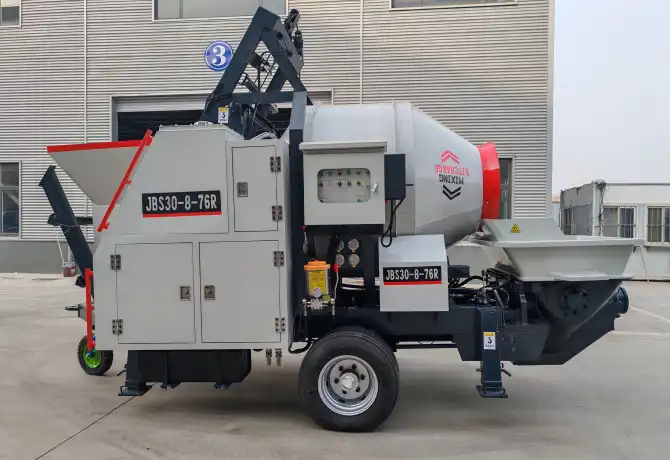
Producción teórica máxima de hormigón: 30 m³/h
Potencia de ingeniería eléctrica: 37 kW
Bomba mezcladora de hormigón eléctrica JBS40

Producción teórica máxima de hormigón: 40 m³/h
Potencia de ingeniería eléctrica: 45 kW
Bomba mezcladora de hormigón diésel JBS30

Producción teórica máxima de hormigón: 30 m³/h
Potencia del motor diésel: 52 kW
Bomba mezcladora de hormigón diésel JBS40

Producción teórica máxima de hormigón: 40 m³/h
Potencia del motor diésel: 82 kW
Bomba mezcladora de hormigón diésel JBS50

Producción teórica máxima de hormigón: 50 m³/h
Potencia del motor diésel: 92 kW

Modelos:
BTB40R-14
Presión máxima de bombeo:
10 MPa
Potencia del motor diésel:
82 kW
Aquí entra en juego nuestra bomba de hormigón con brazo articulado. Ofrece una flexibilidad y eficiencia incomparables, lo que la hace adecuada para proyectos de construcción a gran escala y zonas de difícil acceso.
Hay distintos brazos articulados para colocación de hormigón de bombas con brazo articulado disponibles para su selección, como por ejemplo: 14 m, 20 m, 30 m, 37 m, 44 m, 47 m, etc.
Modelos recomendados:
Bomba de hormigón con brazo articulado BTB40R-14 para proyectos pequeños
Bomba de hormigón con brazo articulado BTB40R-14

Producción teórica máxima de hormigón: 30 m³/h
Potencia del motor diésel: 52 kW
Bomba de hormigón con brazo articulado BTB40R-20

Producción teórica máxima de hormigón: 50 m³/h
Potencia del motor diésel: 92 kW
Bomba de brazo para hormigón BTB40R-30

Producción teórica máxima de hormigón: 40 m³/h
Potencia del motor diésel: 82 kW

Modelos:
HBT6006A-5; HBT6013C-5; HBT6016C-5; HBT8022C-5
Presión máxima de bombeo:
10 MPa
Potencia del motor diésel:
82 kW
La bomba de hormigón montada sobre camión, que ocupa una superficie reducida, facilita su traslado a otro punto de obra, contribuyendo así a aliviar la carga de trabajo del personal de construcción y a mejorar la eficiencia productiva.
Nuestra bomba de hormigón de línea está diseñada para una colocación precisa y controlada del hormigón. Su brazo estrecho y sus mangueras flexibles permiten un vertido exacto en espacios reducidos o secciones complejas de una estructura.
Modelos recomendados:
Bomba de hormigón montada sobre camión HBT6016C-5 para necesidades elevadas de producción de hormigón
Bomba de hormigón montada sobre camión HBT6006A-5, eléctrica/diésel

Producción teórica máxima de hormigón: 30 m³/h
Potencia del motor diésel: 75/115 kW
Bomba de hormigón montada sobre camión HBT6013C-5, eléctrica/diésel

Producción teórica máxima de hormigón: 40 m³/h
Potencia del motor diésel: 90/115 kW
Bomba de hormigón montada sobre camión HBT6016C-5, eléctrica/diésel

Producción teórica máxima de hormigón: 50 m³/h
Potencia del motor diésel: 110/186 kW
Bomba de hormigón montada sobre camión HBT8022C-5, eléctrica/diésel

Producción teórica máxima de hormigón: 50 m³/h
Potencia del motor diésel: 110/120 kW
Especificaciones de la bomba de hormigón
Especificaciones detalladas de la bomba de hormigón montada sobre remolque diésel
| Modelo | HBTSB40-10-82R | HBTSB60-13-129R | HBT80-16-129C | HBT90C-18-176R | |
| Rendimiento teórico máximo de hormigón (L/h) | m³/h | 40/26 | 67/45 | 84/50 | 95/55 |
| Presión máxima de bombeo de hormigón (alta/baja) | MPa | 10/7.6 | 7/13 | 16/8.6 | 18/9.3 |
| Tipo de válvula de distribución | Válvula en forma de S | Válvula en forma de S | Válvula en forma de S | Válvula en forma de S | |
| Diámetro del cilindro de hormigón × carrera | mm | Φ180×1200 | Φ200×1650 | Ф200×1800 | Ф200×1800 |
| Capacidad de la tolva × altura de alimentación | L/mm | 400/1100 | 800/1400 | 800×1400 | |
| Diámetro de la salida | mm | Φ150 | Φ180 | Ф180 | Ф180 |
| Modelo del motor diésel | Weifang Delier 6105ZB | Wechai | Weichai | Weichai | |
| Potencia eléctrica total | kW | 82 | 129 | 129 | 176 |
| Velocidad de rotación | r/min | 2100 | 2200 | 2200 | 2200 |
| Tipo de circuito | Circuito abierto | Circuito abierto | Circuito abierto | Circuito abierto | |
| Presión del sistema de bombeo | MPa | 32 | 32 | 32 | 32 |
| Presión del sistema de mezcla | MPa | 6-8 | 6-8 | 8 | 8 |
| Capacidad del depósito de aceite | L | 370 | 370 | 580 | 580 |
| Distancia máxima teórica de transporte vertical/horizontal | m | 120/500 | 120/500 | 120/500 | 120/500 |
| Diámetro máximo del árido | mm | Grava/arena: 40/50 | Grava/arena: 40/50 | Grava/arena: 40/50 | Grava/arena: 40/50 |
| Diámetro interior de la tubería de descarga | mm | Φ125 | Φ125 | Ф125 | Ф125 |
| Dimensiones: largo × ancho × alto | mm | 5000 × 1850 × 1700 | 5800 × 2000 × 1750 | 6000 × 2200 × 2250 | 6000 × 2200 × 2250 |
Especificaciones detalladas de la bomba de hormigón eléctrica sobre remolque
| Artículo | HBTS30 | HBTS40 | HBTS50 | HBTS60 | HBTS80 |
| Caudal teórico máximo (m³/h) | 30 | 40 | 50 | 60 | 88 |
| Presión máxima de bombeo (MPa) | 10 | 10 | 10 | 13 | 16 |
| Distancia vertical máxima de transporte teórica (m) | 140 | 200 | 120 | 280 | 300 |
| Distancia horizontal máxima de transporte teórica (m) | 450 | 800 | 500 | 1000 | 1200 |
| Diámetro máximo del árido (mm) | 30 | 40 | 50 | 30 | 30 |
| Radio del tubo de transporte (mm) | 100 | 160 | 160 | 180 | 180 |
| Número de cilindros de transporte (unidad) | 2 | 2 | 2 | 2 | 2 |
| Diámetro del cilindro de transporte × carrera del pistón (mm) | Φ140×1000 | Φ160×1000 | Φ200×1000 | Φ200×1600 | Φ200×1800 |
| Capacidad del depósito de aceite hidráulico (L) | 250 | 400 | 500 | 600 | 800 |
| Capacidad de la tolva (m³) | 0.35 | 0.4 | 0.5 | 0.6 | 0.8 |
| Potencia del motor eléctrico principal (kW) | 45 | 45 | 55 | 90 | 110 |
Especificaciones detalladas de la bomba mezcladora de hormigón accionada por diesel:
| Artículo | Tipo diesel JBS30-10-52R | Tipo diesel JBS40-10-82R | Tipo diesel JBS50-10-92R | |
| Rendimiento teórico máximo de hormigón (L/h) | m³/h | 30 | 40 | 50 |
| Capacidad nominal de alimentación de la mezcladora | m³ | 0.56 | 0.56 | 0.56 |
| Capacidad nominal de descarga de la mezcladora | m³ | 0.45 | 0.45 | 0.45 |
| Presión máxima de bombeo de hormigón (alta/baja) | MPa | 6 | 10 | 10 |
| Tipo de válvula de distribución | Válvula en forma de S | Válvula en forma de S | Válvula en forma de S | |
| Diámetro del cilindro de hormigón × carrera | mm | Φ180 × 500 | Φ180 × 800 | Φ180 × 1000 |
| Modelo del motor diésel | Yuchai/Weichai | Weichai Deutz WP4G110E220 | Yuchai 92 kW | |
| Potencia del motor diésel | kW | 52 | 82 | 92 |
| Tipo de circuito | Circuito abierto | Circuito abierto | Circuito abierto | |
| Distancia máxima teórica de transporte vertical/horizontal | m | 100/300 | 100/400 | 100/450 |
| Diámetro máximo del árido | mm | Grava/arena: 20~40 | Grava/arena: 40/50 | Grava/arena: 40/50 |
Especificaciones detalladas de la bomba de brazo para hormigón:
| Modelo | BTB40R-14 |
| Producción teórica máxima de hormigón (m³/h) | 40 |
| Presión máxima de bombeo de hormigón (MPa) | 10 |
| Tipo de válvula de distribución | Válvula en forma de S |
| Diámetro × carrera del cilindro de hormigón (mm) | Ø180 × 1300 |
| Capacidad de la tolva (L) | 500 |
| Diámetro de la salida (mm) | Ø150 |
| Altura vertical de la pluma (m) | 15.4 |
| Radio de colocación del hormigón (m) | 13–16 |
| Longitud del brazo grande (m) | 6.5 |
| Ángulo de elevación del brazo grande (°) | 90 |
| Longitud del brazo pequeño (m) | 6.5 |
| Ángulo de elevación del brazo pequeño (°) | 235 |
| Tubería para hormigón (m) | 125*3 |
| Ángulo de rotación de la torre (°) | 200 |
| Anchura de apertura de las patas (m) | 5.5 |
| Control de la dirección de la varilla distribuidora | Manualmente |
| Modelo del motor diesel () | Weichai WP4G110E220 |
| Potencia del motor (kW) | 82 |
| Velocidad de rotación (RPM) | 2200 |
| Motor diesel para desplazamiento | 32 CV |
| Neumático | 4*8.25*16 |
| Diámetro máximo del árido (mm) | 30 |
| Diámetro interior del tubo de bombeo (mm) | Ø100 |
| Dimensiones: largo × ancho × alto (mm) | 7500 × 2200 × 2920 |
Especificaciones detalladas de la bomba de hormigón montada en camión con motor diésel:
| Artículo | Modelo | HBT6006A-5D | HBT6013C-5D | HBT6016C-5D | HBT8018C-5D | HBT12020C-5D |
| Dimensiones (L×A×A) | mm | 6787*2099*2628 | 6695*2068*2068 | 6736*2125*2628 | 7161*2125*2628 | 7413*2125*2900 |
| Altura de alimentación | mm | 1415 | 1320 | 1420 | 1420 | 1420 |
| Peso bruto | kg | 6300 | 6100 | 6600 | 7300 | 9100 |
| Presión máxima de bombeo | MPa | 7 | 8/13 | 10/16 | 10/18 | 13/21 |
| Rendimiento máximo | m³/h | 70 | 65/40 | 75/45 | 85/50 | 120/75 |
| Cilindro de bombeo (diámetro/carrera) | mm | 200/1400 | 200/1400 | 200/1800 | 200/1800 | 200/2100 |
| Potencia del motor | kW | 115 | 115 | 186 | 186 | 273 |
| Capacidad de las tolvas | m³ | 0.6 | 0.7 | 0.7 | 0.7 | 0.7 |
Especificaciones detalladas de la bomba de hormigón montada en camión con motor eléctrico:
| Artículo | Modelo | HBT6006A-5 | HBT6013C-5 | HBT6016C-5 | HBT8022C-5 |
| Dimensiones (L×A×A) | mm | 6587 *2099 *2232 | 6095*2100 *2232 | 6495*2100* 2232 | 7215*2125*2540 |
| Altura de alimentación | mm | 1415 | 1320 | 1320 | 1420 |
| Peso bruto | kg | 6100 | 6130 | 6600 | 10520 |
| Presión máxima de bombeo | MPa | 7 | 8/13 | 10/16 | 14/22 |
| Rendimiento máximo | m³/h | 70 | 65/40 | 70/45 | 85/50 |
| Cilindro de bombeo (diámetro/carrera) | mm | 200/1400 | 200/1400 | 200/1800 | 200/2100 |
| Potencia del motor | kW | 75 | 90 | 110 | 2*110 |
| Capacidad de las tolvas | m³ | 0.6 | 0.7 | 0.7 | 0.7 |
¿Por qué invertir en bombas de hormigón?
Invertir en bombas de hormigón puede resultar beneficioso por diversas razones. A continuación, se enumeran algunas ventajas clave:
- IMayor eficiencia: Las bombas de hormigón permiten la colocación precisa y eficiente del hormigón. Pueden bombear hormigón a mayor velocidad y con mayor exactitud, lo que acelera el proceso y reduce los requisitos de mano de obra. Esto puede traducirse en importantes ahorros de tiempo y costes en los proyectos de construcción.
- Versatilidad: Las bombas de hormigón están disponibles en diversos tamaños y configuraciones, lo que permite su uso en una amplia gama de proyectos de construcción, desde pequeñas obras residenciales hasta grandes proyectos comerciales e infraestructurales. Se pueden transportar y montar fácilmente en distintos lugares, lo que las hace adecuadas para diferentes tipos de obras y aplicaciones.
- Mejora de la calidad: Las bombas de hormigón contribuyen a garantizar una colocación uniforme y consistente del hormigón, reduciendo la probabilidad de segregación y otros problemas de calidad. La entrega controlada y precisa del hormigón también minimiza las posibilidades de sobrellenado o subllenado, lo que da lugar a un producto final de mayor calidad.
- Seguridad y reducción de la mano de obra: El uso de bombas de hormigón elimina la necesidad de vertido manual, lo que reduce la carga física sobre los trabajadores y minimiza el riesgo de lesiones. Asimismo, permite un mejor acceso a zonas de difícil alcance, como edificios de gran altura o obras subterráneas, reduciendo la necesidad de andamios u otro equipo de acceso.
- Ahorro de costes: Aunque las bombas de hormigón suponen una inversión inicial considerable, la mayor eficiencia y productividad que ofrecen pueden generar ahorros de costes a largo plazo. Una ejecución más rápida de las obras, una menor necesidad de mano de obra y un mejor control de calidad pueden traducirse en unos costes totales del proyecto más bajos.
En conjunto, invertir en bombas de hormigón puede contribuir a incrementar la productividad en la construcción, mejorar la calidad, potenciar la seguridad y, en última instancia, favorecer el éxito de los proyectos de construcción.

. Características
Las ventajas de nuestra bomba de hormigón
El modelo pequeño es ligero y fácil de mover, ideal para proyectos de construcción pequeños;
El sistema hidráulico completo puede prolongar la vida útil de los componentes, mejorar la fiabilidad del equipo, reducir la tasa de fallos y disminuir los costos de mantenimiento;
La válvula en forma de «S» está fundida con acero manganeso austenítico y ofrece las dos ventajas combinadas de resistencia a alta presión y resistencia al desgaste;
Los principales componentes eléctricos provienen de las empresas Schneider y LG, y la fiabilidad del sistema de control eléctrico está altamente reconocida;
Las placas de vidrio y los anillos de corte están fabricados con una aleación de alta dureza resistente al desgaste, lo que les confiere una larga vida útil;
Consideraciones sobre el costo de la bomba de hormigón
Al evaluar el costo de adquisición de una bomba de hormigón, es fundamental ir más allá de la inversión inicial y considerar el impacto financiero a largo plazo. Aunque es cierto que las bombas de hormigón representan un gasto considerable desde el principio, ofrecen importantes beneficios que pueden superar dicho desembolso inicial.
En primer lugar, la mayor productividad y eficiencia que brinda una bomba de hormigón puede traducirse en importantes ahorros de tiempo y mano de obra. Una colocación más precisa del hormigón reduce la necesidad de retrabajos, lo que implica menos desperdicio de materiales y un producto final de mayor calidad. Estos factores contribuyen a reducir los costos totales en los proyectos de construcción.
Además, deben tenerse en cuenta los costos de mantenimiento y reparación. Es fundamental elegir un fabricante de renombre con una red de servicio fiable y piezas de repuesto fácilmente disponibles. Un mantenimiento preventivo regular puede ayudar a prolongar la vida útil de la bomba y evitar averías costosas. Evaluar estos factores permite determinar con mayor precisión el costo real de propiedad y operación de una bomba de hormigón durante su ciclo de vida útil.
Asimismo, debe considerarse el valor de reventa de una bomba de hormigón bien mantenida. Por lo general, las bombas de alta calidad conservan su valor y pueden venderse fácilmente en el mercado de equipos usados, lo que representa un posible retorno de la inversión al actualizar o sustituir la bomba.
En conjunto, aunque el costo inicial de una bomba de hormigón constituye una consideración importante, resulta esencial evaluar los beneficios a largo plazo, como la mejora de la eficiencia, el ahorro de tiempo, la reducción de los costos laborales y el potencial valor de reventa. Al analizar el costo total de propiedad, los compradores pueden tomar una decisión informada que se ajuste a su presupuesto y a las necesidades del proyecto.
¿Comprar nueva, usada o alquilar una bomba de hormigón?
Decidir si comprar nueva, usada o alquilar una bomba de hormigón depende de varios factores, entre ellos los requisitos del proyecto, el presupuesto y el uso previsto a largo plazo. A continuación se presentan algunas consideraciones para cada opción:
1. Razones para comprar una bomba de hormigón nueva:
- Adecuado para empresas con necesidades frecuentes de bombeo de hormigón o proyectos a largo plazo.
- Ofrece la ventaja de poseer el equipo en su totalidad y tener un control completo sobre su uso.
- Brinda la oportunidad de personalizar la bomba según requisitos específicos.
- Generalmente incluye garantía y soporte posventa.
- Requiere una inversión inicial significativa, que incluye los costos de mantenimiento, operación y almacenamiento.
2. ¿Por qué comprar una bomba de hormigón usada?
- Puede ser una opción rentable, especialmente para pequeñas empresas o proyectos con presupuesto limitado.
- Permite la posesión de una bomba de hormigón a un costo inicial más bajo que la compra de una nueva.
- Requiere una inspección cuidadosa para garantizar el estado y el funcionamiento del equipo usado.
- Puede requerir costos adicionales de mantenimiento y reparación.
- La disponibilidad de bombas usadas puede variar, y encontrar el equipo adecuado puede llevar tiempo.
3. ¿Por qué alquilar una bomba de hormigón?
- Es más adecuado para proyectos a corto plazo o necesidades ocasionales de bombeo de hormigón.
- Requiere una inversión inicial mínima, ya que las empresas de alquiler se encargan del mantenimiento y el almacenamiento.
- Proporciona acceso a una variedad de bombas de hormigón con distintas capacidades y especificaciones.
- Los costos de alquiler pueden resultar más elevados a largo plazo si la necesidad de bombeo de hormigón persiste.
- El alquiler puede tener limitaciones en cuanto a disponibilidad y programación, especialmente durante los períodos de mayor actividad en la construcción.
Al tomar una decisión, es fundamental evaluar los requisitos específicos de su proyecto, analizar el presupuesto y considerar la utilización a largo plazo del equipo. Consultar con profesionales del sector o proveedores de equipos también puede ofrecer información valiosa y ayudarle a tomar una decisión informada.
Precio de la bomba de hormigón
| Capacidad de descarga (m³) | Precio aproximado |
| Bomba de hormigón sobre remolque | $10.000,00 – $100.000,00 |
| Mezcladora-bomba de hormigón | $15 000,00 – $25 000,00 |
| Bomba de hormigón montada sobre camión | $16 500,00 – $43 000,00 |
| Bomba de hormigón con brazo plegable | $10 000,00 – $500 000,00 |
Nuestras bombas mezcladoras de hormigón tienen precios competitivos, y se ofrece una gama a modo de referencia. No obstante, el costo final puede verse afectado por diversos factores, como el modelo, la capacidad, las características tecnológicas y cualquier especificación adicional que requiera.
El precio también puede variar según los servicios de personalización que elija, ya que nos esforzamos por satisfacer las necesidades específicas de su proyecto y sus restricciones presupuestarias. Ofrecemos un servicio personalizado que le permite adaptar su bomba mezcladora de hormigón exactamente a sus requisitos.
Recuerde que invertir en nuestro equipo no se trata únicamente del costo inicial, sino del valor, la eficiencia y los ahorros a largo plazo que este le brinda.
Casos globales
Bomba mezcladora eléctrica de hormigón JBS40 en Guyana

Bomba de hormigón remolcable HBTSB60 en Kenia

Bomba de hormigón remolcable HBTS40 en Canadá

Bomba de hormigón remolcable LHBT 80 en Zambia

Factores a considerar al comprar una bomba de hormigón
A continuación se indican otros factores a tener en cuenta al adquirir una bomba de hormigón:
Requisitos del proyecto: Evalúe las necesidades específicas de sus proyectos, incluido el tipo de hormigón que se utilizará, la distancia y la altura de colocación del hormigón, así como el volumen de salida previsto. Asegúrese de que la bomba de hormigón que elija pueda satisfacer eficazmente estos requisitos.
Tipo de bomba: Existen distintos tipos de bombas de hormigón disponibles, como bombas con brazo articulado, bombas de tubería y bombas especializadas para aplicaciones específicas. Evalúe qué tipo se adapta mejor a los requisitos de su proyecto en cuanto a alcance, maniobrabilidad y versatilidad.
Tamaño y capacidad de la bomba: Considere el tamaño y la capacidad de la bomba de hormigón para asegurarse de que pueda manejar el volumen y la tasa de flujo exigidos por sus proyectos. Deben tenerse en cuenta factores como la longitud del brazo articulado, la capacidad de bombeo y la capacidad de la tolva.
Mantenimiento y servicio: Evalúe la disponibilidad de piezas de repuesto y de soporte técnico para la bomba de hormigón que pretende adquirir. Contar con servicios de mantenimiento fiables y accesibles es fundamental para reducir los tiempos de inactividad y garantizar el rendimiento a largo plazo del equipo.
Nivel de habilidad del operador: Considere la experiencia y el nivel de conocimientos de sus operadores. Algunas bombas de hormigón pueden tener controles y funciones más complejas, lo que exige un mayor nivel de habilidad y capacitación. Elija una bomba que se adapte a las capacidades de su equipo o tenga en cuenta los costos adicionales de formación para los operadores.
Reputación del fabricante: Investigue y elija un fabricante reconocido por producir bombas de hormigón de alta calidad y confiables. Tenga en cuenta su historial, las opiniones de los clientes y los servicios de asistencia al cliente.
Características de seguridad: Asegúrese de que la bomba de hormigón cuente con las características de seguridad adecuadas, como sistemas de estabilidad del brazo articulado, botones de parada de emergencia, opciones de control remoto y alarmas de seguridad. La seguridad debe ser una prioridad máxima para proteger a los trabajadores y prevenir accidentes.
Análisis de costos: Evalúe el costo inicial de adquisición, incluidas las características opcionales adicionales que requiera, así como los posibles costos a largo plazo, tales como mantenimiento, reparaciones y consumibles (por ejemplo, piezas sujetas a desgaste, lubricantes). Compare distintas opciones para determinar la alternativa más rentable dentro de su presupuesto.
Consideraciones medioambientales: Busque bombas de hormigón diseñadas para ser respetuosas con el medio ambiente, con características como menor consumo de combustible, niveles reducidos de ruido y emisiones. Elegir una opción ambientalmente responsable se alinea con las prácticas de construcción sostenible y ecológica.
Valor de reventa: Aunque no sea una preocupación inmediata, vale la pena considerar el posible valor de reventa futuro de la bomba de hormigón si planea actualizarla o venderla más adelante. Determinadas marcas o modelos pueden tener un valor de reventa más alto, lo cual puede afectar su inversión a largo plazo.
Recuerde consultar con profesionales del sector, proveedores de equipos u operadores experimentados para obtener más información y orientación detallada al tomar su decisión de compra.
Principios de funcionamiento de la bomba de hormigón

El principio de funcionamiento de una bomba de hormigón implica varios componentes y procesos clave. A continuación se ofrece una explicación simplificada de cómo opera una bomba de hormigón:
- Embudo de hormigón: La bomba de hormigón comienza con un embudo que almacena la mezcla líquida de hormigón. El embudo está conectado a un sistema de alimentación o a una cinta transportadora que suministra de forma continua hormigón a la bomba.
- Válvula en S o válvula de roca: En el interior de la bomba de hormigón hay un mecanismo de válvula en S o válvula de roca. Esta válvula, normalmente fabricada en acero, se encarga de controlar el flujo de hormigón. Está compuesta por dos lengüetas con forma cóncava que alternan entre abrirse y cerrarse. Cuando una lengüeta se abre, la otra se cierra, creando un sellado que evita el retroceso del hormigón.
- Pistones y cilindros: La bomba de hormigón también contiene cilindros hidráulicos y pistones alternativos. Estos componentes trabajan conjuntamente para generar la presión necesaria que impulsa el hormigón a través del sistema. Al retraerse los pistones, se crea un vacío y el hormigón es aspirado hacia el cilindro de la bomba.
- Sistema de bombeo de hormigón: Una vez que los pistones se extienden, el hormigón es expulsado del cilindro hacia el sistema de descarga. La válvula en S dirige el flujo de hormigón a través de la tubería o manguera de entrega.
- Tubería o manguera de entrega: El hormigón se transporta mediante una tubería o manguera de entrega hasta su ubicación deseada. La longitud de la tubería o manguera determina la distancia máxima a la que puede bombearse el hormigón, y puede alargarse o acortarse según sea necesario.
- Extensión de la pluma (si corresponde): Si la bomba de hormigón dispone de una pluma, esta puede extenderse y articulare para alcanzar zonas de difícil acceso. La pluma se controla hidráulicamente, lo que permite una colocación precisa del hormigón a distintas alturas y distancias.
- Funcionamiento continuo: La bomba de hormigón opera en un ciclo continuo. Siempre que haya un flujo constante de hormigón desde la tolva, la bomba puede aspirarlo continuamente y expulsarlo a través del sistema de bombeo.
Es importante señalar que existen distintos tipos de bombas de hormigón, como las montadas sobre camión, las montadas sobre remolque y las estacionarias, cada una con variaciones propias en diseño y funcionamiento. No obstante, los principios básicos son los mismos: transferir el hormigón desde la tolva, mediante un mecanismo de válvulas, hasta el sistema de bombeo para su colocación en la obra.
Aplicaciones de las bombas de hormigón
Las bombas de hormigón son equipos de construcción versátiles, ampliamente utilizados en diversas aplicaciones. A continuación se enumeran algunas de las aplicaciones más comunes:
Construcción de edificios altos: Las bombas de hormigón se emplean extensamente en proyectos de construcción de edificios altos. Gracias a su capacidad para alcanzar grandes alturas y largas distancias horizontales, garantizan la colocación eficiente y oportuna del hormigón en estructuras elevadas. Ofrecen precisión y velocidad al suministrar hormigón a distintos pisos, sin las limitaciones de métodos tradicionales como grúas y cubos.
Proyectos de infraestructura a gran escala: Las bombas de hormigón son fundamentales en la construcción de proyectos de infraestructura a gran escala, tales como puentes, túneles, presas y carreteras. Estos proyectos suelen requerir la colocación rápida y precisa de grandes volúmenes de hormigón. Las bombas de hormigón pueden transportar fácilmente el hormigón a largas distancias y acceder a ubicaciones difíciles, permitiendo así una colocación eficiente en estructuras complejas.
Construcción residencial: Las bombas de hormigón también se utilizan en proyectos de construcción residencial, especialmente en cimentaciones, entradas de vehículos o soleras de sótanos. Con una bomba de hormigón, los contratistas pueden asegurar una colocación uniforme y continua del hormigón, lo que contribuye a mejorar la resistencia y durabilidad de las estructuras. Asimismo, la mayor eficiencia del bombeo reduce los requerimientos de mano de obra y optimiza los plazos de construcción.
Ubicaciones remotas: En proyectos donde el acceso y la logística resulten complicados —por ejemplo, en obras remotas o en lugares con acceso vial limitado—, las bombas de hormigón constituyen una herramienta inestimable. Pueden instalarse sobre remolques o camiones y trasladarse hasta la obra, posibilitando la entrega de hormigón a zonas donde los métodos tradicionales resultarían poco prácticos o incluso imposibles.
Pavimentación con encofrado deslizante: Las bombas de hormigón desempeñan un papel fundamental en la pavimentación con encofrado deslizante, técnica comúnmente empleada en la construcción de carreteras y grandes superficies de pavimento de hormigón. La bomba suministra hormigón al encofrado deslizante, asegurando un flujo continuo y uniforme. Esto permite moldear y nivelar con precisión el hormigón, obteniendo superficies viales lisas y duraderas.
Suelos industriales: En entornos industriales y comerciales, donde se requieren superficies de suelo grandes, planas y duraderas, se utilizan bombas de hormigón para lograr una colocación óptima del hormigón. Ya sea para almacenes, fábricas o espacios comerciales, la alta eficiencia de las bombas de hormigón permite suministrar y colocar el hormigón de forma rápida y precisa, garantizando una base robusta para pavimentos industriales.
Estos son solo algunos ejemplos de las numerosas aplicaciones en las que se emplean las bombas de hormigón. Su versatilidad, eficiencia y capacidad para acceder a ubicaciones difíciles las convierten en una herramienta esencial en los proyectos de construcción modernos, optimizando las operaciones y mejorando los resultados generales del proyecto.
Tendencias del mercado y perspectivas futuras
Las tendencias del mercado desempeñan un papel fundamental en la industria de las bombas de hormigón, y es importante que los compradores se mantengan informados sobre los últimos avances. Una tendencia destacada es la creciente adopción de tecnologías avanzadas en las bombas de hormigón.
Las funciones de automatización, como la operación mediante control remoto y la supervisión de datos, se están volviendo más comunes, lo que mejora la eficiencia y reduce la fatiga del operador. Se prevé que esta tendencia continúe a medida que los fabricantes inviertan en investigación y desarrollo para mejorar el rendimiento y las capacidades de sus bombas.
Otra tendencia significativa es el enfoque en soluciones respetuosas con el medio ambiente. En conjunto, la industria de la construcción está adoptando prácticas sostenibles, y el sector de las bombas de hormigón no constituye una excepción. Los fabricantes están desarrollando bombas más eficientes energéticamente que reducen las emisiones y cumplen con normativas ambientales cada vez más estrictas. Estas bombas no solo disminuyen la huella de carbono, sino que también ofrecen ahorros económicos a largo plazo al reducir el consumo de combustible.
Además, el uso de telemática y análisis de datos en tiempo real va en aumento. Actualmente, las bombas de hormigón avanzadas están equipadas con sensores que monitorean el rendimiento de la bomba, el flujo de hormigón y otros parámetros críticos. Estos datos en tiempo real permiten a los operadores y a los gestores de proyectos tomar decisiones fundamentadas, optimizar el uso de la bomba y garantizar un mantenimiento oportuno, mejorando así la eficiencia general del proyecto.
Otros equipos que podría necesitar
Capacidad: 40-320 t/h
Capacidad: 25-240 m³/h
Potencia nominal: 36,8-110 kW
Retropaladora para terrenos irregulares
Capacidad: 3-10 toneladas
Capacidad: 1,2-6,5 m³
. Certificaciones
Nuestras certificaciones



 English
  Spanish
  French
  Russian
  Arabic
  Portuguese
  Italian
  Turkish
  Georgian
  Indonesian